

Building pathways beyond the classroom at Whakatane High School
29 May 2026, PlaceMakers News, Prove Your Know How
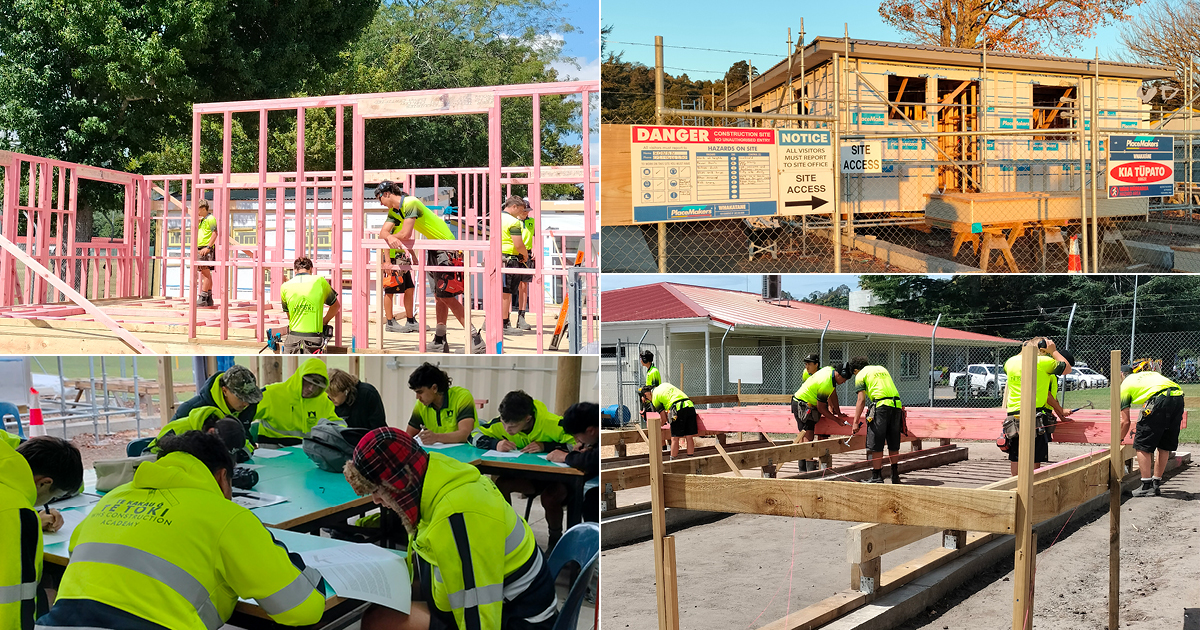

A hands-on pre-apprenticeship programme at Whakatāne High School is delivering measurable results for students – with support from PlaceMakers helping bring real-world construction experience into reach
Whakatāne High School’s pre-building apprenticeship programme is reshaping how some students engage with education – and what they see as possible beyond it.
Designed for students who are less drawn to traditional classroom learning, the initiative focuses on practical, trade-based experience.
Ronan Carton leads the programme, and says the aim is to support students as they transition from school to the workplace, “specifically at students who are more hands-on learners and more inclined to go into trades rather than tertiary education”.
The programme is not a simulation. Students are building two transportable homes for Kāinga Ora, working through every stage of construction. From subfloor and framing through to roofing, interior lining and joinery, they are exposed to the full build process.
“Students work alongside carpenters, plumbers, sparkies and painters so they get exposure to those trades,” explains Carton.
Once completed, the homes are transported to locations determined by Kāinga Ora, explains Carton.
Engaged and passionate
Carton says the student’s genuine interest in the project is immediate and measurable – attendance increases, build quality improves and feedback is very positive.
One of the clearest indicators is a reduction in material wastage. At the start of a project, wastage can sit at around 30%. By the end, it drops to between 10 and15% – a level comparable with qualified builders’ wastage.
“The reduction in wastage tells us they understand the value of the material and [that] everything has a cost,” says Carton. “Ultimately, it shows that they care about what they are doing.”
This shift is tracked through material quantities. Early in the build, additional materials are often required. As students progress, usage aligns closely with initial estimates – a sign of increasing precision and planning.
The gains extend beyond technical skills. Attendance improves significantly, rising on average from 50% to 90%. Carton links this directly to student engagement.
“They are a lot happier in themselves due to the fact [that] they enjoy what they’re doing,” he says. “In the end, they are achieving a sense of purpose and belonging through real, visible results.”
That sense of ownership is reinforced by the finished product.
“Being able to look at a house they built gives an immense sense of pride,” he says.
The programme is also creating pathways into employment. Of the 12 students who completed the course last year, several have moved directly into the workforce.
“Three are now in building apprenticeships, one is engaged in a drain laying apprenticeship, one is roofing, and another is working in construction retail,” says Carton.
Vital industry support
Industry involvement is central to making the programme work. Suppliers such as PlaceMakers Whakatāne play a key role in ensuring materials, pricing and logistics align with the realities of a live build environment.
“Industry support is vital,” says Carton. “Good relationships are key to success in checking orders, squeezing in orders at short notice, organising site visits, ensuring quality materials and service at the right price.”
PlaceMakers has supported the programme since its inception three years ago – a relationship that grew naturally from an existing customer connection according to PlaceMakers Whakatāne Account Manager Mark Lefort.
“The teacher involved was already a client of PlaceMakers, and through that solid relationship of good service and going the extra mile, it was a no-brainer for the relationship to grow,” he says.
That support extends beyond supply. Lefort says the team works to provide “absolutely market leading pricing to help continue the viability of the programme”, alongside smaller contributions such as accessories and invitations to trade events.
The broader goal is to give students exposure to building and the wider construction ecosystem. In June, students will travel to Fieldays in Hamilton, with visits planned to the PlaceMakers WAIBOP Frame and Truss plant as well as Steel & Tube.
“The aim is to give them a better understanding of what goes into the pre-nail frames and roofing iron they work with every day,” says Lefort.
Important exposure
Carton says these experiences are critical in helping students explore the diversity of the industry.
“Site visits enable the students to get exposure to other fields they may have never considered,” he says. “By showing them as many different aspects of the industry as possible, it opens up a world of possibilities they otherwise wouldn’t even know existed.”
The Fieldays trip also serves as recognition: “It is also a thank you to the kids,” Barsdell says. “They get a field trip to visit places they might not otherwise see.”
As the programme continues, there are plans to expand, following a similar model already in place at Ōpōtiki College, where students transition into paid apprenticeships while supporting new pre-apprenticeship learners.
For Whakatāne High School, the results to date are clear – improved engagement, practical skills and defined pathways into employment. With ongoing support from industry partners, including PlaceMakers, the programme is building more than houses. It’s building confidence, capability and future careers.
Register to earn LBP Points Sign in
1 Comment
Leave a Reply
You must be logged in to post a comment.
Its good bringing in students at this age and teaching them and reshaping thier interest in the building.