
Know your small building fire obligations
02 Jun 2026, Building & Housing, Industry News, News, Prove Your Know How, Regulatory
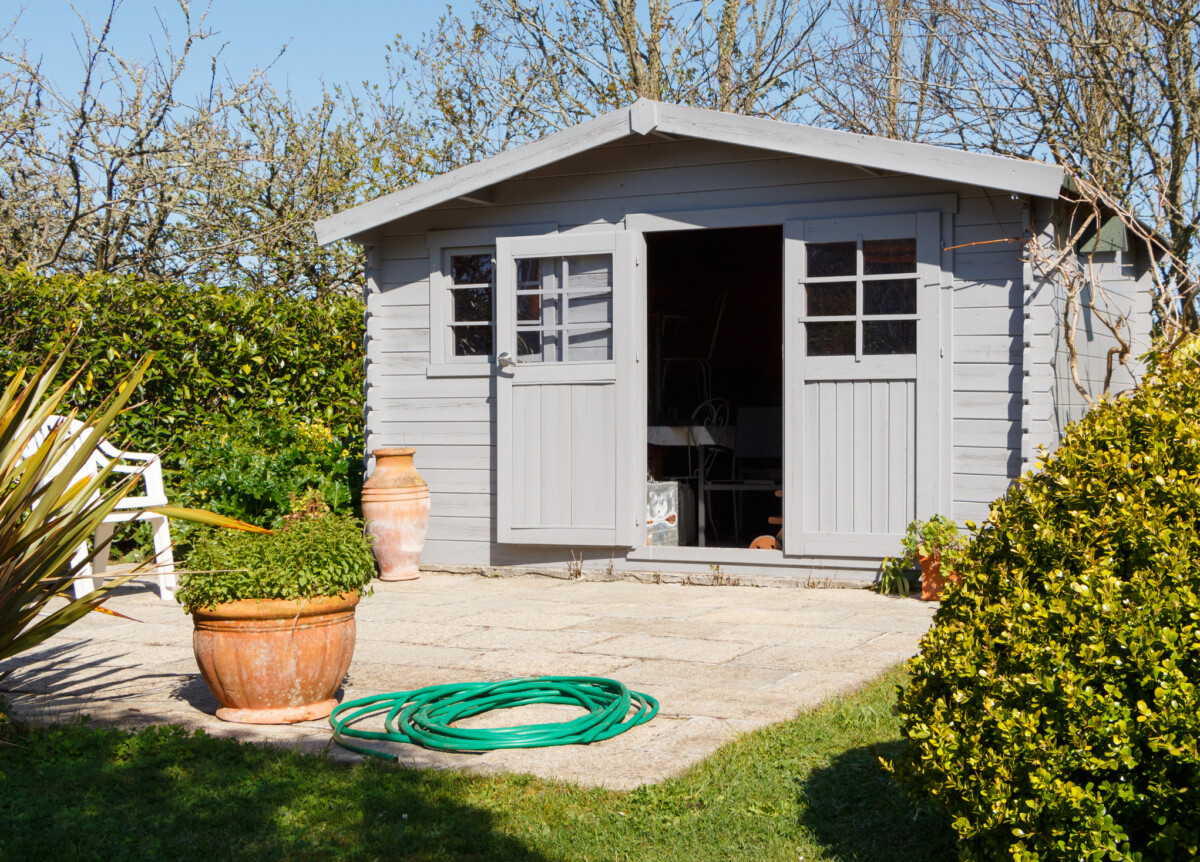
Building garden sheds and other small buildings without a building consent? If closer than 1m to the boundary, be aware building code fire clauses apply
In October 2025, the Government announced that some buildings up to 10m2 may be positioned up to a boundary or another building on the same property without a building consent. Previously, all buildings needed to be built at least 1m away from a legal boundary or another building on the same property.
To qualify for this exemption, a detached building not exceeding a 10m2 floor area can be built without a building consent if it:
- Is not more than one storey (being a floor level of up to 1m above the supporting ground and a height of up to 3.5m above the floor level).
- Does not exceed 10m2 in floor area.
- Does not contain sanitary facilities or facilities for the storage of potable water.
- Does not include sleeping accommodation, unless the building is used in connection with a dwelling
- If it includes sleeping accommodation, it needs to have smoke alarms installed
- Does not contain cooking facilities.
- Complies with the Building Code.
Expanded scope of work
It may not seem much, but being able to build a 10m2 building close to the boundary expands the scope of work builders and homeowners can do without requiring a building consent. However, the proximity triggers some extra requirements for buildings encroaching the 1m setback, such as Building Code Clauses C3.6 and C3.7, which stipulate that buildings must be constructed in a way that prevents fire spreading to other properties.
Building Code Clause C3.6 states that buildings must be designed and constructed so that in the event of fire in the building, the received radiation at the relevant boundary of the property does not exceed 30kW/m2 and, at a distance of 1m beyond the relevant boundary of the property, does not exceed 16kW/m2.
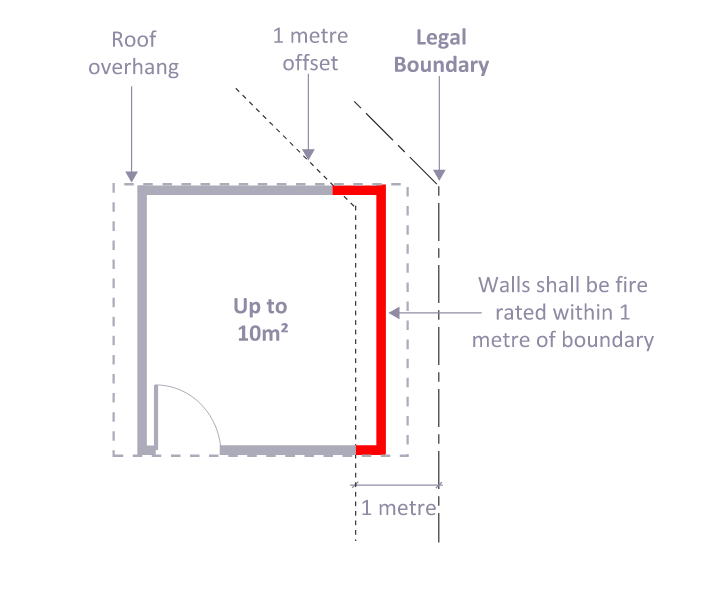
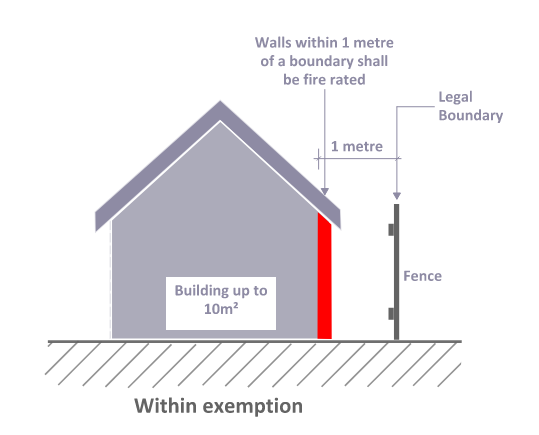
Building Code Clause C3.7 states that external walls of buildings that are located closer than 1m to the relevant boundary of the property on which the building stands must either:
- Be constructed from materials which are not combustible building materials, or
- For buildings in Importance Levels 1 and 2, be constructed from materials that, when subjected to a radiant flux of 30 kW/m2, do not ignite for 15 minutes.
If you haven’t come across them before, Importance Levels are defined in Building Code clause A3. They basically assign risk for the purposes of clauses C1-C6 Protection from fire. A building is given an Importance Level from 1 to 5 determined by risk to human life, the environment, economic cost and other risk factors in relation to its use.
Importance Level 1 buildings are defined as ‘Buildings posing low risk to human life or the environment, or a low economic cost, should the building fail’. These are typically small non-habitable buildings, such as sheds, barns, and the like, that are not normally occupied, though they may have occupants from time to time and do include tramping huts.
Importance Level 2 buildings are ‘Buildings posing normal risk to human life or the environment, or a normal economic cost, should the building fail’. These are typical residential, commercial, and industrial buildings.
Any builder working on consent-free buildings must be sure to understand their liability and insurance obligations. For more information, visit the MBIE website.
Note: This article does not cover RMA requirements such as height in relation to boundary restrictions which also need to be factored into the design of any building near the boundary.
Register to earn LBP Points Sign in