

Sleep outs are not granny flats – part three
18 May 2026, Building & Housing, Industry News, Prove Your Know How, Regulatory
Part three of this BRANZ bulletin explains the Schedule 1 exemptions for sleepouts, including what’s allowed, the conditions that apply and when building or resource consent may still be required
Sleepouts are often treated as a simple, consent-free alternative to small dwellings – but the distinction is more restrictive than many builders and homeowners realise.
Under Schedule 1 of the Building Act, sleepouts can be built without building consent only if they meet specific conditions, that they do not have kitchens and sanitary facilities.
That means they are not interchangeable with small stand-alone dwellings, commonly referred to as granny flats, which operate under a separate exemption framework.
This series has already covered conditions that apply to sleepout exemptions and the exemption requirements that allow homeowners to carry out the largest amount of design and construction work themselves. Next, we cover local authority requirements.
In each city or district council’s district/unitary plan and other planning documents, there are rules that sleepouts must comply with, as all buildings must unless there is a specific legal exemption. These rules determine whether a sleepout can be built on a property in the first place and, if so, where it can be located on the property and what other rules it must comply with.
Recession planes
District and unitary plans limit the maximum height of a building relative to the boundary with a daylight recession plane (Figure 3). Recession planes typically run at an angle of 45° or 55° from a spot 2.5m above ground on the boundary. No part of the sleepout can be above the recession plane (or resource consent may be required if it is). Depending on the building design, the recession plane rules may mean that a sleepout must be built at a greater distance from the boundary than the minimum setback distance in Schedule 1.

Site coverage, minimum permeable area, outdoor living space
Site coverage is the maximum area of a property that can be covered with buildings. It often needs to be less than 40% or 50% but can be as little as 30% or as much as 60%. For example, if you already have a 140m² house on a 320m² section and the limit in your area is 50%, you can add a sleepout up to 20m² but not up to 30m².
Many councils have a minimum area of the property that needs to be permeable (with grass, planting or permeable paving) so rainwater can soak into the ground. For example, a typical urban general residential zone may require 30% of the surface area to be permeable, but check with your local council to confirm the minimum area required.
Some urban residential zones require minimum areas of continuous outdoor living space. A common requirement is a minimum of 30 to 60m² that is directly accessible from the house. Some councils also require this area to have a minimum length or width such as at least 5m across.
Stormwater disposal
Councils around the country have slightly different requirements around handling stormwater from a new building such as a sleepout. In some cases, pipes carrying water collected from the roof can be connected directly into the existing private stormwater drain on site and discharged into the public stormwater drain (the stormwater system).
Public stormwater drains are not available or accessible in all areas. Some councils and network utility operators do not allow additional stormwater to be discharged into their networks, particularly where there are capacity constraints.
If the stormwater cannot be connected to the public stormwater system, another method of disposal will need to be found. This should be discussed with the local council to identify its specific requirements.
Stormwater drainage off the sleepout must not affect existing neighbouring properties or buildings. If a soak pit is to be constructed on site, this itself is likely to require building consent, and in some circumstances may even require resource consent. The requirements for constructing a soak pit are set out in Verification Method E1/VM1. The calculations required are not simple and are best done by someone with experience. In addition, most local authorities specify minimum distances between soak pits and existing buildings and property boundaries. Some have their own specific requirements around soak pit construction.
All stormwater drainage work must be undertaken by a registered drainlayer.
Natural hazards
In locations vulnerable to natural hazards such as flooding or landslide, there may be council restrictions on whether new buildings can be constructed or whether they can only be constructed on a particular part of the site. No buildings, including sleepouts, should be constructed on an overland flood path. Many councils have online maps identifying areas at risk of natural hazards.
Geographic zones
New Zealand is divided into a series of geographic zones that define the type and level of risk that a building faces. Many rules around the design and construction of new buildings depend on the zones they are being constructed in. These are the main zones:
- Four earthquake zones, from 1 to 4, with 1 being the parts of New Zealand at the lowest risk of earthquakes and 4 the highest risk. A map showing these zones can be found in NZS 3604:2011 Figure 5.4. Homes and sleepouts in zones that have stronger earthquakes may need stronger bracing in foundations, wall and roof framing.
- Five wind zones – low, medium, high, very high and extra high. Where the wind is over 55m/s – above the extra high zone – an engineer must be consulted for the design. While NZS 3604:2011 shows wind regions, to establish the wind zone for a specific site, an engineer may need to be consulted. Local councils may provide guidance on wind zones in their area but may not have site-specific data beyond urban residential areas. Homes and sleepouts in zones that have stronger winds may need stronger bracing in foundations, wall and roof framing.
- Three exposure/corrosivity zones – Zone B (inland areas with lowest risk of material corrosion), Zone C (coastal areas with medium risk) and Zone D (coastal areas with high risk). These zones can be found in NZS 3604:2011 Figure 4.2. For homes and sleepouts very close to the coast, exposed metal elements such as fixings must be made from stainless steel to protect against corrosion from salt.
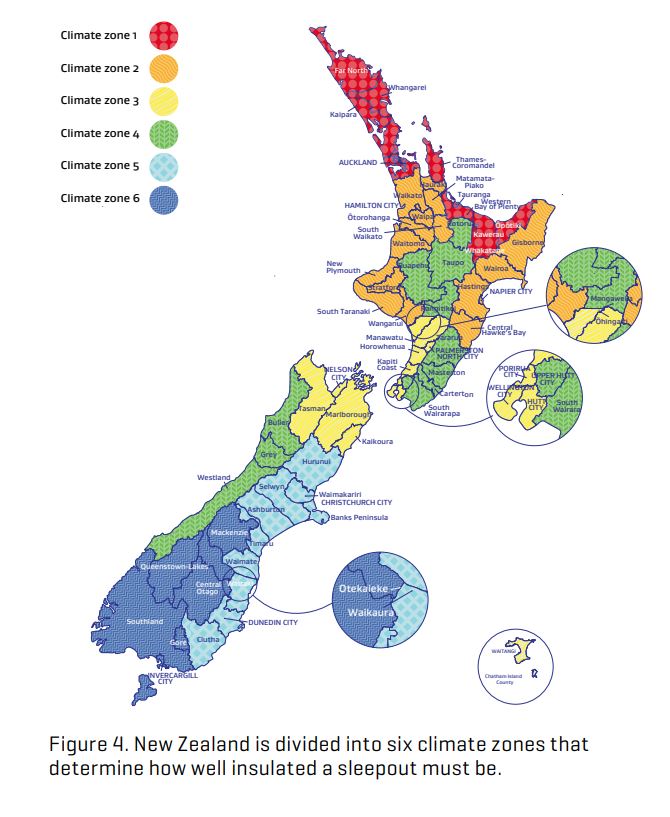
- Six climate zones (Figure 4), from the warmest parts of the country to the coldest. These zones can be found in the H1 Acceptable Solutions and Verification Methods. Homes and sleepouts in colder parts of the country need higher levels of insulation and higher-performing windows to keep them warm in winter.
Councils can provide details of the zones that apply in their areas. The zones for a particular property can also be found using the BRANZ Maps online tool.
Getting outside help
Some work on a sleepout can only be carried out by registered practitioners:
- All stormwater drainage work must be undertaken by a registered drainlayer.
- The electrical connection between the sleepout and the house must be made by a registered electrical worker and a certificate of compliance must be provided on completion.
- In locations where wind speeds can be extreme – above the extra high zone – an engineer must be consulted at the design stage to help determine bracing requirements. This category of work is called specific design (SD).
- If there is any doubt about whether the land the sleepout is to be built on meets the requirements of good ground, a chartered professional engineer or other experienced professional should be consulted.
There are other areas where outside help is not a legal requirement but can still have major benefits. For example, during the design work, calculations must be made for bracing requirements in the floor, walls and roof. Someone who has never done bracing calculations before may find it difficult, time-consuming and stressful. Asking an LBP – a draughtsperson, designer, engineer or similar – who has done these calculations many times before may be a time-saving step. Depending on who does the work, the cost may not be high. If in doubt about anything, seek professional help.
More information
There is a substantial amount of information online, especially on the MBIE website and on city and district council websites. BRANZ recommends talking to local council staff to determine the current council requirements that apply to sleepouts.
Register to earn LBP Points Sign in
2 Comments
Leave a Reply
You must be logged in to post a comment.

Informative
If in doubt ask where wind speeds can be a extreme.